
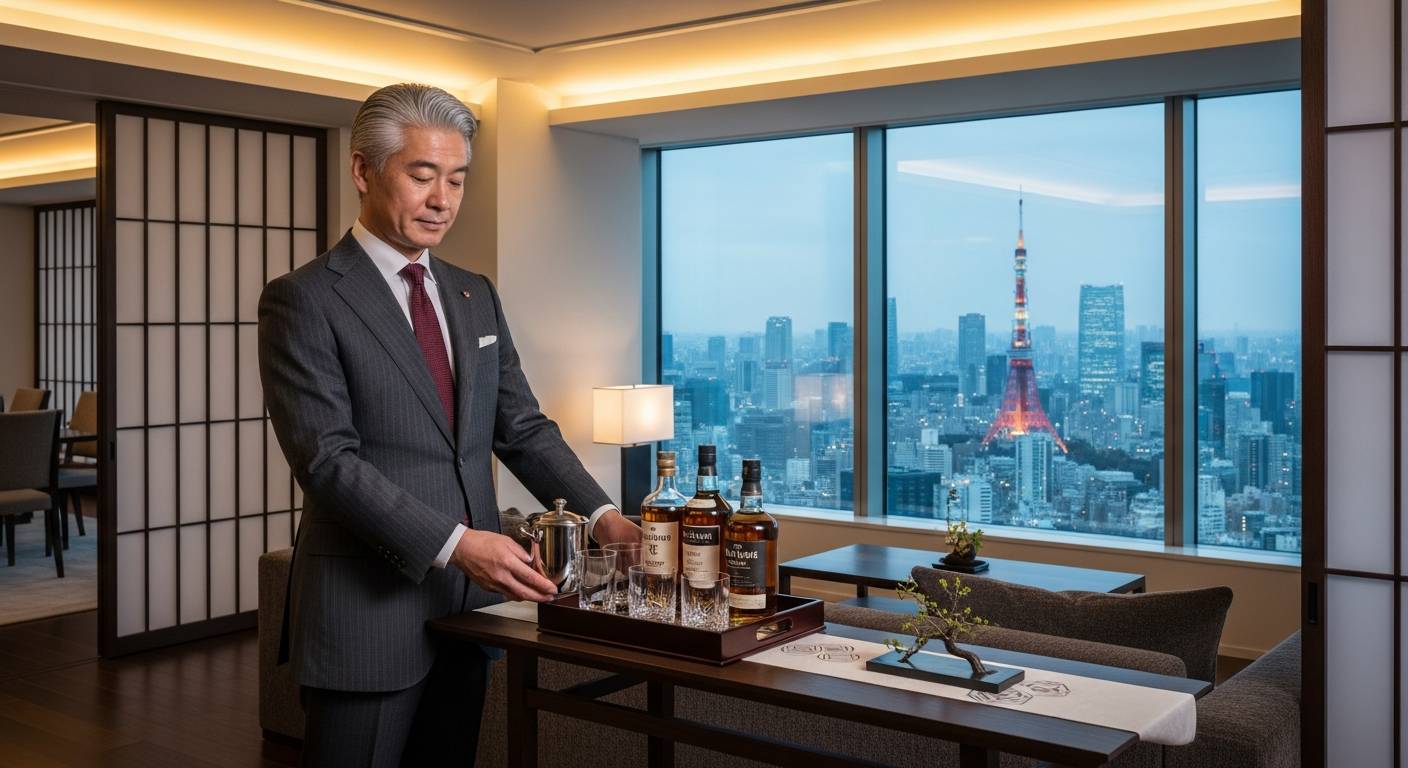
In the rarefied world of ultra-luxury services, Japan has quietly established itself as a global leader in high-end butler and concierge services that cater exclusively to High Net Worth Individuals (HNWIs). While much attention focuses on Japan’s technological innovations or traditional arts, the sophisticated butler industry operates discreetly behind the scenes, generating significant economic impact while setting new global standards for personalized service excellence.
This comprehensive analysis delves into the fascinating economics and operational structure of Japan’s elite butler service industry – a sector that remains largely invisible to the general public yet forms an essential support system for global wealth holders residing in or visiting Japan. From the substantial compensation packages commanded by Japan’s top butlers to the rigorous training ecosystems that produce these exceptional professionals, we’ll explore how the principles of Japanese Omotenashi have been transformed into a premium service commodity that commands extraordinary fees from those who demand nothing less than perfection.
Whether you’re interested in luxury market trends, considering a career in high-end hospitality, or simply curious about how the ultra-wealthy navigate life in Japan, this insider’s guide will provide unprecedented insights into a world where discretion meets economic opportunity in the service of exclusivity.
1. The Hidden Luxury Economy: How Japan’s HNWI Butler Services Generate $500M Annually
Japan’s ultra-exclusive butler service industry represents a fascinating economic microcosm that few outsiders ever glimpse. This rarified sector, catering exclusively to High Net Worth Individuals (HNWIs), generates an estimated $500 million annually—a figure that remains largely invisible in mainstream economic analyses. The industry operates on principles of absolute discretion, with premier agencies like Tokyo Butler Academy and Platinum Service Japan maintaining strict client confidentiality while commanding premium fees starting at ¥2.5 million ($22,000) monthly for a full-time household butler.
What drives this robust economic ecosystem is Japan’s unique concentration of wealth. With over 3.4 million millionaires and the third-highest number of ultra-high-net-worth individuals globally, Japan provides fertile ground for specialized luxury services. The butler industry has evolved to incorporate traditional Japanese omotenashi hospitality principles with European formal service standards, creating a distinctive service model that commands premium pricing.
The economic impact extends far beyond direct employment. Each butler position typically supports an entire ecosystem of luxury providers—from bespoke uniform tailors to specialized training academies and exclusive supplier networks. Industry insiders report that a single HNWI household employing butler staff typically injects between ¥30-50 million ($270,000-$450,000) annually into the luxury service economy through staffing, training, and procurement channels.
Market analysis reveals that demand consistently outpaces supply, with top agencies maintaining waiting lists for their most qualified personnel. This scarcity drives compensation packages that include not only substantial salaries but often housing allowances, international travel, and performance bonuses that can double base compensation. The result is an industry where discretion and excellence create extraordinary economic value in an environment where price sensitivity is virtually nonexistent.
2. Inside Japan’s Elite Butler Industry: Why Global Billionaires Are Paying Premium for Japanese Service Standards
Japan’s elite butler industry has emerged as the gold standard for ultra-high-net-worth individuals seeking unparalleled household management. This sector, once confined to imperial households and traditional ryotei establishments, has evolved into a sophisticated industry catering to global billionaires and royal families who demand perfection in domestic service.
The Japanese approach to butler service differentiates itself through several key elements. First is the concept of “omotenashi” – anticipatory hospitality that goes beyond Western service traditions. Japanese butlers are trained to predict needs before they arise, creating a seamless environment where requests rarely need verbalization. This invisible attention to detail commands premium rates starting at $150,000 annually for entry-level positions and exceeding $500,000 for head butlers with elite clientele.
Elite training academies like the Tokyo Butler Academy and International Butler Institute’s Japan branch maintain rigorous standards, with acceptance rates below 5%. Graduates undergo intensive training in traditional Japanese arts alongside Western service protocols – from tea ceremony precision to wine service, from kimono care to managing complex household staff hierarchies across multiple international residences.
What truly distinguishes Japanese butler services is their holistic approach to household management. Beyond standard duties, these professionals excel in crisis management, navigating cultural sensitivities, and maintaining absolute discretion – qualities particularly valued by Middle Eastern royalty, tech billionaires, and old-wealth European families maintaining multiple residences in Asia.
The economic model reflects this exclusivity. Placement agencies like Tokyo Premium Staff and Gingko Butler Services operate on invitation-only models, with client waitlists extending years. The significant investment these agencies make in vetting, training and placing candidates is reflected in their 30-40% commission structures – fees readily absorbed by clients who understand the value proposition of impeccable service.
Industry analysts note that demand has consistently outpaced supply, particularly as Asian wealth expansion creates new client bases seeking status symbols beyond material acquisitions. The resulting economic ecosystem supports specialized training, procurement networks for rare household goods, and concierge services designed exclusively for butler-managed households.
3. From $100K to $1M: The Surprising Economics Behind Japan’s Top-Tier Butler Services
The ultra-luxury butler service industry catering to High-Net-Worth Individuals (HNWIs) in Japan operates on a financial scale that few outsiders comprehend. Entry-level professional butler services start at approximately $100,000 annually, but the upper echelons of this profession can command fees exceeding $1 million – figures that reflect not merely service provision but the creation of seamless, personalized lifestyles for Japan’s elite.
What drives this remarkable price spectrum? At the foundation lies comprehensive training. Elite butlers typically complete rigorous programs at institutions like the International Butler Academy or the British Butler Institute, investing $15,000-$30,000 in their professional development. Many Japanese premium service providers require additional specialized training in Japanese hospitality principles (omotenashi), cultural nuances, and regional etiquette, adding $20,000-$50,000 to their skill investment.
The significant price differential between standard and premium butler services emerges from several key factors. First, exclusivity contracts prevent top-tier butlers from serving multiple clients simultaneously, commanding premium compensation for this dedication. Second, specialized expertise in areas like fine art management, wine collection curation, or international property coordination adds substantial value. Third, the highest-paid butlers typically demonstrate multilingual fluency, with Japanese, English, and often Mandarin or French capabilities commanding 30-40% compensation premiums.
Mitsubishi Estate Residence’s ultra-luxury condominium developments have pioneered the integration of dedicated butler services into residential offerings, with prices reflecting this amenity. Similarly, Mitsui Fudosan’s premium serviced residences feature dedicated butler staff, with property values implicitly incorporating this exclusive service component.
For Japan’s financial elite, the investment in premier butler services yields returns beyond convenience. These professionals function as lifestyle architects, wealth preservation specialists, and cultural navigators – roles that justify their extraordinary compensation. The true value proposition lies not in traditional service metrics but in the creation of frictionless existence for individuals whose time valuation makes such investments economically rational.
4. How Japanese Butler Academies Are Creating a New Class of Luxury Service Professionals
The emergence of specialized butler academies across Japan marks a significant shift in the luxury service landscape. These institutions are not merely training staff; they’re cultivating a new professional class that bridges traditional Japanese omotenashi (hospitality) with international butler standards demanded by high-net-worth individuals.
Japan’s premier butler training institutions, such as the Tokyo Butler Academy and International Butler Academy Japan, have developed comprehensive curricula that transform ordinary service workers into elite household professionals. Training programs typically span 6-12 weeks of intensive instruction, covering everything from wine service and wardrobe management to security protocols and cultural sensitivity.
What distinguishes Japanese butler academies is their meticulous attention to both technical skills and psychological preparation. Students learn to anticipate needs before they’re expressed – a hallmark of Japanese service culture – while also mastering the discretion and formal etiquette expected in international contexts. The fusion creates a uniquely Japanese butler archetype that has become increasingly sought-after among global elites.
The economic model of these academies is telling: tuition often exceeds $10,000 for comprehensive programs, yet demand remains robust. Graduates can expect starting salaries between ¥6-12 million annually ($40,000-$80,000), with experienced butlers serving prominent families commanding upwards of ¥20 million ($135,000) plus accommodations and benefits.
Notable is the demographic shift occurring within these academies. While traditionally dominated by men, Japanese butler schools now report approximately 40% female enrollment, reflecting the industry’s modernization. Additionally, mid-career professionals from hospitality, luxury retail, and even corporate sectors are increasingly viewing butler training as a prestigious career pivot.
The curriculum itself reveals much about the evolving demands of HNWI employers. Beyond traditional service skills, today’s butler students receive training in digital privacy protection, cryptocurrency management, sustainability practices for luxury properties, and cross-cultural communication essential for international households.
These academies maintain close relationships with luxury hotel groups, private staffing agencies, and wealthy family offices, creating a pipeline that virtually guarantees employment for top graduates. The Icho Butler Academy in Kyoto, for instance, reports a 98% placement rate, with approximately 30% of graduates securing positions with international employers.
As Japan positions itself as a luxury destination and more global wealth flows into the country, these academies are responding by expanding their offerings to include specialized courses in yacht management, art collection maintenance, and private aviation service – reflecting the diversifying demands of ultra-high-net-worth clients.
5. The Investment Returns of Excellence: Why HNWIs Consider Japanese Butler Services Essential, Not Optional
For High Net Worth Individuals (HNWIs), the calculation of value extends far beyond mere monetary cost. When examining the economics of Japanese butler services, we must understand that these elite clients view such services through the lens of investment rather than expense. The returns—while not always quantifiable on a traditional balance sheet—are substantial and multifaceted.
Japanese butler services deliver exceptional ROI through time optimization. When a butler manages household logistics, scheduling, and daily minutiae, HNWIs recapture their most precious commodity: time. This recovered time translates directly to expanded business opportunities, deeper personal relationships, and improved well-being—assets of immeasurable value.
The precision of Japanese butler service also provides significant risk mitigation. Consider the potential costs of a poorly planned business dinner, mismanaged household staff, or compromised security arrangements. A single error in these domains can result in substantial financial and reputational damage. Japanese butlers, trained in anticipatory service, function as sophisticated risk management systems.
Moreover, Japanese butler services offer privacy and discretion in an age where these qualities command premium pricing. A dedicated butler creates a buffer zone around HNWIs, filtering access and information flow. In a world where reputation and information constitute critical currency, this protective function represents extraordinary value.
The cultural competence of Japanese butlers particularly enhances their worth in international contexts. Their understanding of Japanese business etiquette alongside global protocols creates seamless experiences for clients with international interests. Companies like Nihon Butler Academy have built their reputation on this cross-cultural expertise, making them indispensable to HNWIs with global portfolios.
Perhaps most significantly, Japanese butler services provide consistency in an inconsistent world. The psychological comfort of knowing every detail will be handled to exacting standards allows HNWIs to operate at peak capacity in their professional endeavors. This stability serves as the foundation upon which wealth can be further developed and preserved.
The exclusivity factor also cannot be underestimated. In certain circles, having a Japanese-trained butler has become a subtle signifier of discernment and success. This social capital, while difficult to quantify, opens doors and creates connections that directly impact wealth creation opportunities.
When these benefits are calculated together, the economics become clear. Japanese butler services aren’t luxury expenditures but strategic investments that generate returns across multiple dimensions of the HNWI lifestyle. This explains why, even during economic downturns, demand for top-tier Japanese butler services remains remarkably stable—they’re considered essential infrastructure for wealth management rather than optional luxuries.