
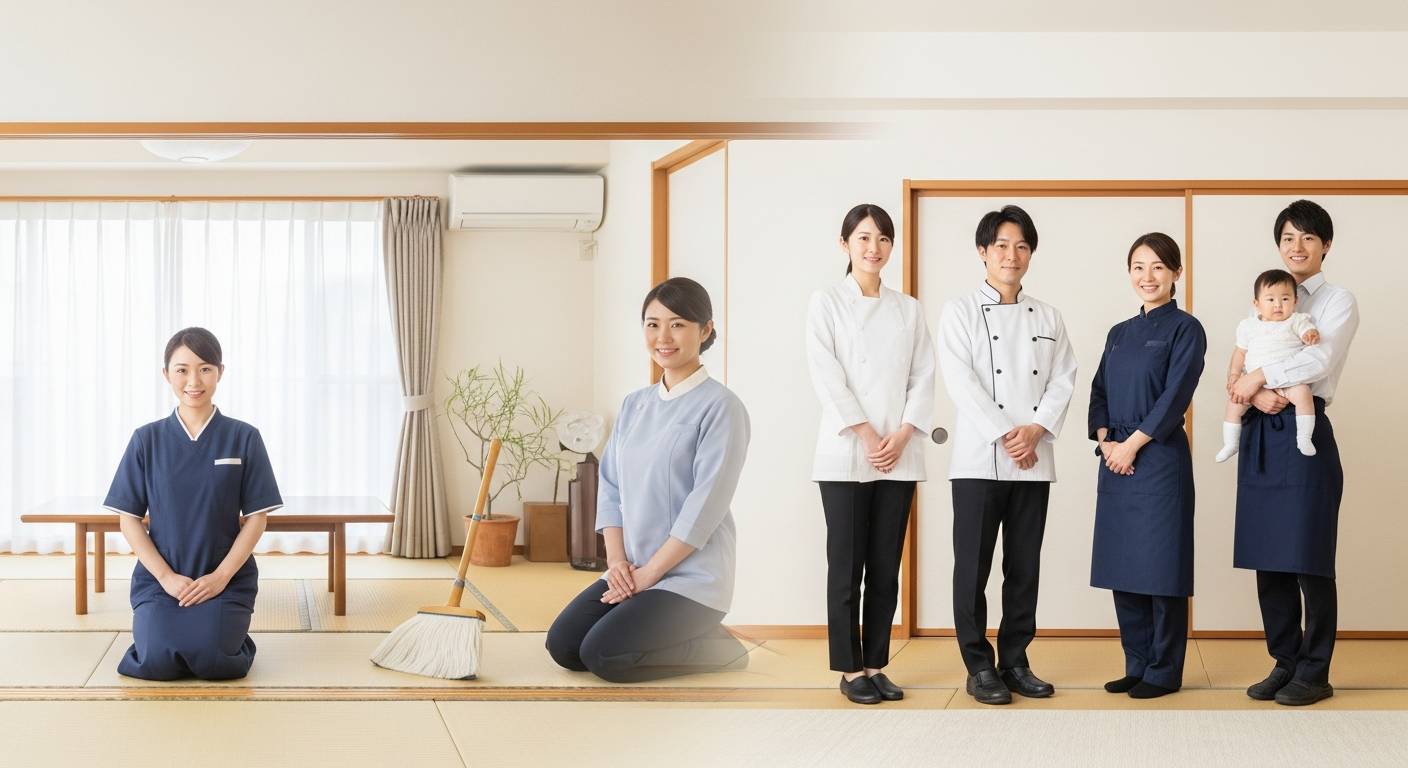
Welcome to an exploration of Japan’s remarkable journey in the service industry, where traditional housemaid services have evolved into sophisticated lifestyle management solutions. In today’s fast-paced world, the concept of service in Japan has transformed dramatically, reflecting both cultural shifts and the changing needs of global clients seeking premium support. This evolution represents not just a change in service offerings, but a fundamental reimagining of how personalized attention can enhance quality of life.
For expatriates, international executives, and discerning travelers in Japan, understanding this evolution provides valuable insight into the exceptional level of support now available. From the meticulous attention to detail found in traditional housekeeping to the comprehensive lifestyle management services offered by modern butler and concierge professionals, Japan’s service industry stands as a beacon of excellence in the global hospitality landscape.
Join us as we examine how Japanese service philosophy has been refined over generations, combining time-honored traditions with contemporary luxury standards to create truly exceptional lifestyle experiences. Whether you’re considering relocating to Japan or simply fascinated by the art of supreme hospitality, this exploration of Japan’s service evolution promises valuable insights into one of the world’s most sophisticated service cultures.
1. Elevating Service Standards: How Japan Transformed Housemaid Work into Elite Lifestyle Management
Japan has long been renowned for its exceptional service culture, where attention to detail and customer satisfaction reign supreme. Nowhere is this evolution more apparent than in the transformation of traditional housemaid services into sophisticated lifestyle management solutions. What once began as basic cleaning and household maintenance has blossomed into a comprehensive ecosystem of premium domestic support that caters to the modern Japanese household’s complex needs.
The traditional “kaseifu” (household helper) role has undergone a remarkable metamorphosis in response to changing social dynamics. As dual-income households became the norm and time became an increasingly precious commodity, the demand for more sophisticated home management services surged. Companies like Duskin and Bears recognized this shift early, expanding beyond simple cleaning to offer tailored packages that include everything from specialized deep-cleaning to home organization systems.
This transformation isn’t merely about adding services—it represents a fundamental shift in how domestic help is perceived and valued. Today’s elite household management professionals in Japan often possess specialized training in areas like interior organization, textile care, and even nutritional meal planning. Prestigious agencies such as Pasona and Poppins have established rigorous training programs that certify their staff in multiple domestic competencies, elevating the profession’s status.
Technology has been a powerful catalyst in this evolution. Modern Japanese household service providers leverage sophisticated scheduling systems, specialized equipment, and even AI-powered solutions to deliver precision service. For instance, leading provider CaSy connects clients with vetted professionals through a streamlined digital platform, allowing for transparent pricing and specialized service matching.
The contemporary Japanese approach to household management also reflects a deeper cultural value: the importance of creating harmonious living spaces that support mental wellbeing. Beyond mere cleanliness, today’s premium services incorporate elements of traditional concepts like “ma” (negative space) and “seiri-seiton” (organization principles) to create environments that reduce stress and enhance quality of life.
This elevation of domestic service has created meaningful career paths where none existed before. What was once viewed as temporary or low-status employment has become a legitimate professional track with advancement opportunities. Companies like Bears and Duskin now offer management tracks for their top-performing staff, complete with competitive benefits packages and continuous professional development.
Japan’s transformation of housemaid services demonstrates how a society can revolutionize traditional roles through professionalization, technology integration, and cultural alignment. As other countries face similar challenges with work-life balance, this distinctly Japanese approach to household management offers valuable insights into creating service innovations that genuinely enhance quality of life.
2. The Luxury Revolution: Japan’s Journey from Basic Housekeeping to High-End Concierge Services
Japan’s domestic service industry has undergone a remarkable transformation over the past decades, evolving from traditional housemaid services to sophisticated lifestyle management solutions. This luxury revolution represents not just a change in service offerings, but a fundamental shift in how Japanese society approaches work-life balance and personal well-being.
In metropolitan areas like Tokyo and Osaka, premium concierge companies such as Tokyo Concierge and Pasona Life Support have redefined what domestic assistance means. These services offer far more than basic cleaning and cooking – they provide comprehensive lifestyle management including travel arrangements, event planning, personal shopping, and even art procurement.
The emergence of these high-end services coincides with Japan’s economic maturation and the growing number of dual-income households among urban professionals. For many busy executives, the value proposition is clear: outsourcing life’s administrative tasks creates space for meaningful experiences and relationships.
Technological integration has further elevated these services. Companies like Bears now offer app-based platforms where clients can customize service packages, schedule appointments, and communicate preferences with unprecedented precision. This tech-enabled personalization has become a hallmark of Japan’s premium domestic service sector.
Perhaps most notable is the industry’s emphasis on discretion and etiquette. Elite service providers undergo rigorous training not only in practical skills but in the nuanced social protocols that distinguish luxury service. This attention to cultural refinement reflects Japan’s traditional values while meeting contemporary expectations for professionalism.
The economic impact of this sector expansion cannot be overstated. The luxury domestic service industry has created thousands of skilled jobs and generated significant revenue streams, contributing to Japan’s service-oriented economy. As international residents and business travelers increasingly seek these conveniences, the sector continues to adapt with multilingual staff and culturally sensitive service approaches.
Japan’s journey from basic housekeeping to sophisticated concierge services illustrates a broader economic narrative – one where value creation increasingly depends on personalization, expertise, and time-saving solutions rather than mere labor substitution.
3. Beyond Cleaning: How Japanese Hospitality Evolved into World-Class Lifestyle Support Systems
Japanese hospitality services have transcended their traditional boundaries, evolving from basic housekeeping into sophisticated lifestyle management systems. This transformation reflects Japan’s response to changing social dynamics, technological advancement, and increasing demand for personalized support services.
The concept of “omotenashi”—Japan’s distinct approach to hospitality—has been reimagined for modern needs. Companies like Pasona Heartful, which began as a simple cleaning service, now offers comprehensive elder care, childcare support, and home management solutions. Their “Life Concierge” service helps busy professionals manage everything from household repairs to personal shopping.
Similarly, Duskin, long known for its cleaning services, has expanded into food delivery, health monitoring, and even technology support for seniors. Their holistic approach addresses the challenges of Japan’s aging society while maintaining the meticulous attention to detail that characterizes Japanese service.
Technology integration has been pivotal in this evolution. Services like Bears, a premium housekeeping company, now utilize AI systems to track client preferences across hundreds of parameters. Their staff receives real-time updates through dedicated apps, ensuring consistent service quality regardless of which team member visits a client’s home.
The business model has also shifted from transactional to relationship-based. Casy Inc., a leading domestic staffing agency, now positions itself as a “lifestyle partner” rather than a service provider. Their subscription-based model includes regular home maintenance, seasonal deep cleaning, and personalized support tailored to each family’s lifestyle.
This evolution has created entirely new service categories. TaskRabbit Japan, for example, connects clients with “taskers” who can handle everything from furniture assembly to waiting in line for limited-edition products—tasks that would never have fallen under traditional housekeeping services.
What distinguishes Japanese lifestyle support systems is their holistic approach to well-being. Companies like CaSy don’t just clean homes; they create environments designed to reduce stress and improve quality of life. Their staff receives training in everything from allergies to mood-enhancing interior arrangements.
Perhaps most significantly, these services have democratized access to domestic support. Through efficiency improvements and technology, companies like Bears have made once-exclusive household assistance available to middle-class families, single professionals, and elderly individuals living independently.
The global influence of this Japanese approach is evident as international hospitality chains and service companies increasingly adopt elements of this comprehensive lifestyle support model, recognizing its potential to address similar challenges in aging societies worldwide.